Villeneuve-lès-Avignon faces its big sister, Avignon. Often opposed and yet intimately linked, the two cities face each other on either side of the Rhône.
A former royal city founded during the reign of Philip the Fair, Villeneuve-lès-Avignon reveals an exceptional heritage. Becoming a cardinal's city in the 14th century, it invites visitors to step back in time, amidst medieval fortifications, religious monuments, palaces, gardens, and old houses.
Take the time to stroll through its alleyways with their timeless charm, to wander through its small squares, to push open the doors of its monuments and to enjoy the panoramas over Avignon, the Rhône Valley, Mont Ventoux and the Alpilles.
Villeneuve-lès-Avignon, a city with a rich past

The history of Villeneuve-lès-Avignon is closely linked to that of Avignon and the Rhône River. At the end of the 13th century, King Philip IV the Fair sought to strengthen the presence of the Kingdom of France on this bank of the river, then the border with Provence. The founding charter of Villeneuve was signed in 1292 and notably included provisions for fortifying access to the Avignon bridge.
In the 14th century, the establishment of the popes in Avignon profoundly transformed the territory. Cardinals and great families came to settle in Villeneuve and built palaces, residences and religious monuments there.
The city then became a true cardinal city , whose remarkable heritage can still be discovered today.
The must-sees and must-visit attractions in Villeneuve-lès-Avignon
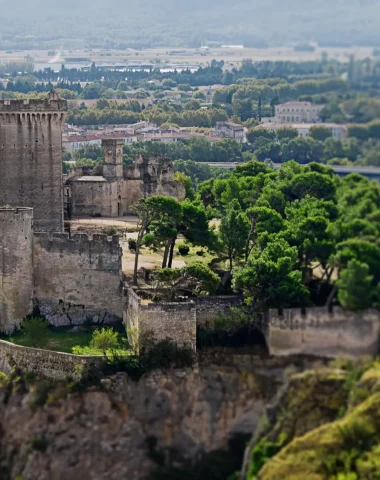
Fort Saint-André 🏰


Perched atop Mount Andaon, Fort Saint-André overlooks Villeneuve-lès-Avignon and faces the Palais des Papes (Palace of the Popes). Its construction addressed a strategic need: to control this section of the Rhône River and protect access to the Avignon bridge from the Kingdom of France. The founding charter of Villeneuve, signed in 1292, already stipulated the fortification of this access point.
From the rampart walk, the view stretches far. Villeneuve-lès-Avignon, Avignon, the Rhône Valley, Mont Ventoux and the Alpilles make up a spectacular panorama.
Not to be missed: the view of the Palace of the Popes from the ramparts.
Saint Andrew's Abbey and its gardens
On the heights of Mount Andaon, Saint Andrew's Abbey blends history, architecture and gardens.
Founded near the tomb of Saint Casaria, the Benedictine abbey experienced its development from the Middle Ages onwards.
Its gardens, designated a Remarkable Garden, extend over two hectares. Olive trees, Mediterranean vegetation, terraces and Italian-inspired gardens create a veritable haven of greenery.

As you stroll along, enjoy magnificent views of the Palais des Papes, Avignon and the Rhône Valley.
The Charterhouse of the Valley of Blessing
Founded in the 14th century by Pope Innocent VI, the Chartreuse du Val de Bénédiction is one of the emblematic monuments of Villeneuve-lès-Avignon.
This immense monastery notably houses the tomb of Pope Innocent VI and a remarkable collection of mural paintings.


Today, the Chartreuse is also a major center for artistic creation. It hosts authors and companies in residence and actively participates in the cultural life of the region.
Our tip: don't miss the view of Fort Saint-André from an opening in the old church. A real photo spot!
The Philippe-le-Bel Tower

At the entrance to the Avignon bridge, the Philippe-le-Bel tower recalls the strategic role of Villeneuve-lès-Avignon in the Middle Ages.
Built at the end of the 13th century, this imposing tower controlled access to the Saint-Bénézet bridge and asserted the power of the kingdom of France against the papal territories.
Climb the steps of its spiral staircase and gain some height to admire the view of Avignon, the Rhône, the surrounding landscapes and the Alpilles.
Our advice: allow approximately 30 minutes for the visit and wear good shoes.
Cyclists 🚴: take advantage of your visit to Villeneuve-lès-Avignon by bike to discover the tower. Bike parking facilities are available nearby.
Villeneuve celebrating
Villeneuve-lès-Avignon is not just about its heritage. Throughout the year, the town hosts cultural and festive events.
Villeneuve on Stage
Every July, Villeneuve en Scène transforms the city into a veritable open-air stage.
This festival of itinerant writing offers a program where theatre meets circus, dance, music and street arts.
Located in particular on the Plaine de l'Abbaye and in the historic centre, the festival is often presented as the "garden of the Avignon Festival".
The Feast of Saint Mark
Every year, on the last weekend of April, Villeneuve-lès-Avignon celebrates Saint-Marc , a traditional festival deeply rooted in local heritage.
Uprooting and burning the stump, dancing around the fire, a solemn mass in Provençal and a parade of carts punctuate this event which celebrates in particular the vine, wine and the hope of good harvests.
Food truck evenings
For a delicious and friendly break, head to Place Charles-David during the food truck evenings organized in town.
Every Monday evening, from 18 pm to 22 pm , enjoy a relaxed atmosphere with a variety of culinary options. As days and times may change, please check the schedule before your visit.

A day in Villeneuve-lès-Avignon
For a first visit to the cardinal's city, here is our suggested itinerary:
- The Philippe-le-Bel Tower
- The historic center and its narrow streets
- The Charterhouse of the Valley of Blessing
- Fort Saint-André
- Saint Andrew's Abbey and its gardens
- The Pierre-de-Luxembourg Museum
Staying near Villeneuve-lès-Avignon
Aire de Camping-cars Beaucaire
Motorhome service / reception area

Gîte 2 personnes – Roland Chaix
Furnished rental and holiday cottage

Séjour Insolite sur le Rhône – Péniche Black Bee Boating
Unusual accommodation


Gîte 4 personnes – Gîte En Petite Camargue
Furnished rental and holiday cottage


2 keys Furnished and Self-Catering Accommodation

Aire de Camping-cars Bellegarde
Motorhome service / reception area


From Beaucaire to Villeneuve-lès-Avignon by bike
What if you discovered Villeneuve-lès-Avignon from the Terre d'Argence?
Beaucaire and Villeneuve-lès-Avignon have several things in common : both are heritage towns located on the right bank of the Rhône and both are on the ViaRhôna route , the cycle route which connects Lake Geneva to the Mediterranean.
A great opportunity to discover the two cities by bike, along the Rhône and through the Mediterranean landscapes.
Discover the route!

To discover nearby


Visites guidées d’une distillerie artisanale en Provence
Bookable online. From €8 per adult.
November 01, 2026 - March 31 , 2027


What is the distance between Villeneuve-lès-Avignon and Avignon?
Avignon and Villeneuve-lès-Avignon face each other and are about 3km apart depending on the destination sought.
The journey time by car is approximately 10 minutes. And 12 minutes by bicycle.
How long does it take to visit Villeneuve-lès-Avignon?
To fully enjoy the city and its attractions, you should allow at least one day.
What to do in Villeneuve-lès-Avignon?
The must-sees in Villeneuve-lès-Avignon are Fort Saint-André, Saint-André Abbey and its gardens, the Chartreuse du Val de Bénédiction and the Philippe-Le-Bel Tower.
