
On the banks of the Rhône, between Arles and Saint-Rémy de Provence, Vallabrègues is a pretty Provençal village whose history is closely linked to the art of basketry. In Vallabrègues, wicker and rattan were woven in every house. The village was also known as the French capital of basketry. There were no fewer than 450 basket makers in the village at the beginning of the XNUMXth century. With the arrival of plastic, basketry gradually disappeared from our daily lives.
Vallabrègues, the basket-making village

Vallabrègues has often experienced the whims of the Rhône River, sometimes finding itself on the right bank, sometimes on the left. Thanks to the Rhône and its floods, Vallabrègues boasts fertile land, ideal for growing willow. In the 19th century, the village's basketry creations were exported throughout France. Today, although practices have changed considerably, the basketry tradition remains evident in Vallabrègues. The Basketry Museum recounts the history of the village and its craft. The Basketry Festival is a must-see event in the summer.
What is the raw material of the basket maker?
Wicker is the essential resource for basketry. Flexible and strong, it is ideal for weaving. The moist soils along the banks of the Rhône are ideal for growing wicker; this is called osiericulture. Wicker is harvested in winter; no treatment is necessary. The basket maker can use raw wicker. He lets it dry naturally. It should be stored in a cool, dry place.
White wicker can also be used. To make it, bundles of wicker are soaked in water until they begin to sap. The bark is then removed and the wicker is left to air dry.
The basket makers of Vallabrègues also used and harvested cane around the village. Provence cane grows on cane bushes along the edges of fields or roads. It is cut in winter, scraped outdoors, and then split into four sections.


The banaste, the emblematic piece of Vallabrègues

In the 3th century, Vallabrègues' reputation was already well established. Baskets were made here, and the basket maker was called a banastié. Baskets were the same packaging used by farmers to ship cherries just a few decades ago. Vallabrègues' fertile land favored cherry cultivation. This led to the production of baskets for their transport. It took one bundle of wicker to make three pairs of 24-inch baskets.
A new vision of basketwork
Long neglected, basketry is making a comeback. Designers like Atelier Vime are reviving it. With its Atelier Vime Editions collection, it collaborates with local and national basket makers. Their pieces are refined, modern, and poetic.


The Basketry Festival: a journey through time
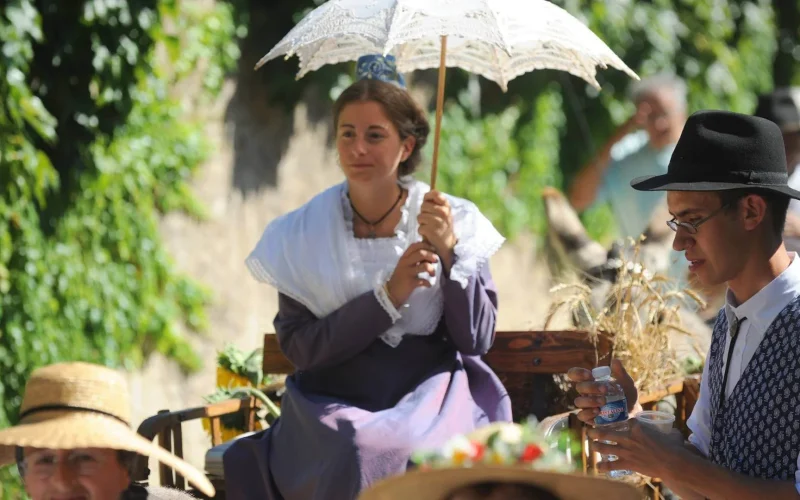
Every year, the charming Provençal village of Vallabrègues, nestled on the left bank of the Rhône, transforms into a veritable paradise for lovers of crafts and traditions. The European Basketry and Fine Craft Festival offers an immersion into ancestral know-how! This festival, with its unique atmosphere, allows…
Where to sleep in Vallabrègues?
3-star, 3-ear-of-wheat furnished accommodation and gîte


3-star campsite

Aire de Camping-cars Vallabrègues
Motorhome service / reception area

Séjour Insolite sur le Rhône – Péniche Black Bee Boating
Unusual accommodation

